Tuesday, October 2, 2012

Duvemåla's Kristina

It's an adaptation based on a classic novel a whole nation adores. It's a huge mammoth of a musical: very long, sung-through, lots of characters. It's confusing. It's filled with show-stopping numbers that literally make the show screech to a halt for five minutes just so we can admire the lead's vocals. At times, it seems like it's constructed to force tears and sadness out of you. I know that there's a lot to fix when it comes to the structure of the piece... But I'm afraid I've hardly ever enjoyed a show this much.

And, for once, I'm not talking about Les Misérables.

Everybody should go see Svenska Teatern's production of Kristina från Duvemåla.


Kristina från Duvemåla tells a story about a group of Swedish people emigrating to the USA in the 19th century. It deals with heavy themes: the decision to move to another country and abandon your old live forever can't be an easy one, and the musical touches issues like death and religion, dreams and love. It's also wildly popular. Performances keep going until next spring, and they're practically all sold out already.

The musical is based on Vilhelm Moberg's The Emigrants series, and I've never seen a musical adaptation this true to its source material. Of course, I read the Finnish translations of the books, but I was still amazed by how closely the dialogue sometimes corresponds with the libretto. Especially the first two books of the series seemed to translate from page to stage without changing a word.

I admire the close accuracy whenever it works, and there are moments when it does, but it's also a problem. I think the books were great reads, but that doesn't mean there aren't any problems in them. Instead of fixing the books' odd bits, though, the musical amplifies them. Moments that are explained badly in the books aren't explained at all in the musical, and following the books too closely results in pretty clumsy storytelling.

For example, there's a scene where the audience meets the young farmhand Arvid for the first time, as he talks with his friend Robert: I'm-going-to-kill-the-old-woman-she-claims-I'm-a-zoophile-no-don't-do-that-dear-friend-I'll-read-to-you-about-rice-and-we-shall-move-to-America-wait-what? The first half of the scene is never mentioned again. The show has some way too fast-paced scenes that are lifted straight from the book. The details originally spread across dozens of pages get crammed into thirty seconds.

The first time I saw Kristina, I was convinced it should get shortened. I'm not so sure anymore, personal preference is overriding sense: I've started to enjoy every overlong minute. But, even so, I probably wouldn't throw a fit over a couple of cuts. There are some things I wish future productions would get rid of.

First, there's the tacky Jesus vision that one of the side characters has. The show's relationship with religion is convoluted enough [Laura talked about this in her Finnish review, check her text out if you know the language] – a campy, glittering Jesus doesn't really make things better. Then there's the very first scene. After the overture, we're shown an old man who has broken his leg, and his son who swears he can take care of the farm. This is one of the worst beginnings for a musical I can recall. It doesn't feel interesting, doesn't introduce us to the title character and has little relevance to the rest of the plot. Why start the show with a character we only meet twice during the following three hours? I think the overture should lead straight into Duvemåla hage, and Karl Oskar telling his bride "the farm is mine, Kristina" would be quite enough background. The very end of the second act also introduces a confusing plot point the show could very well do without.


It would seem natural I'd hate the show, with this many gripes... But that's not how it is. Even with all this, I love Kristina. I don't know if this love will last, but at the moment, it's one of my top five favourite musicals of all times.

As implied earlier, I think Kristina is closely related to Les Misérables. I seem to have a tendency to like musicals like this, ones where bodycount rises, ones that are long and heavy with strong themes. First time watching, both Les Mis and Kristina left me with the same confused feeling: I had a good time, but have no idea what happened there. And still, the performances elevated me. Every time I see these shows, they make me feel lighter, just overall better. They make me enjoy myself.

My reaction to Kristina is quite carthartic. I don't necessarily relate with all the themes the musical deals with, but it still fills me with feelings. I don't cry easily when seeing musicals, but the first time I heard Maria Ylipää sing Du måste finnas, I wept for the next five minutes. Second time watching, the biggest solos didn't make me cry anymore – but everything in between did. I tend to take constant mental notes even during shows I really like, it's hard for me to turn the little critical voice in my head off. So it's fantastic to find a show that lets me forget that from time to time.

The music, by Benny Andersson and Björn Ulvaeus, is gorgeous. I like ABBA songs, but I admit I've never been that into Chess, the duo's other musical (might help if I saw it live, though). But here, I can't get enough of the tunes. Kristina has some of the very best music I've ever heard. It's hard to explain why, it just works for me. If you find the tickets too pricey for you – which wouldn't be surprising, this is the most expensive musical in the whole country – at least find the original cast recording and take a listen.

Not to say seeing the show isn't worth it, though. Svenska Teatern's Kristina joins my mental list of perfect musical casts. It's as if these roles and people were made for each other. There isn't a single weak link. I feel it's useless to go into more depth; I would just mention names and yell "PERFECTION" after each one.

The show also looks good. Judging from the photos I've seen from the Swedish original production, Svenska Teatern's version looks very similar to it, set-wise. The replica strikes, yet again... Luckily, the sets they've copied look great. The staging is pretty minimalistic, and it works. You don't have to show a lot to show exactly where the events are happening. In the first performance I saw, the audience was truely pleased with the visuals: one of the set changes resulted in an applause.


Conclusion?

There are dozens of things to fix in Kristina från Duvemåla when I think about it with sense. But when feelings come into play... If a show can make me feel as strongly as Kristina did, it has done more right than wrong.

Photos by Cata Portin.
See the trailer of the production.

Tuesday, September 25, 2012

Something Next to Normal

A word of warning for starters: written in white text, there are major spoilers for Next to Normal in this review. In my opinion, they will ruin your experience if you don't know the plot of the show. So, please, only highlight the invisible part if you have seen Next to Normal already. (Also, if you ask me, avoid reading the reviews in newspapers. The same spoiler appears there with no warnings.) Other than the white part, this should be safe to read.


Next to Normal is one of the musicals I can't decide whether to call my favourite or not.

In a way, Next to Normal is one of the best musicals of the recent years. With so many jukebox musicals and adaptations nowadays, it's very refreshing to see an original story. It's not an easy one, either: it's about a family struggling with mental ilness. A very interesting subject for a musical, I think.

Yet, I'm afraid every repeat viewing has further opened my eyes to see the weaknesses of the piece. I'm rather annoyed at its black-and-white view about whether to treat mental illnesses with medical science or therapy. The show definitely takes a side, and I think it tries to shove its opinions down our throats a bit too forcibly. Next to Normal also has a rather weak second act. The combination of the songs being less interesting and the action slowing down near the end is sure to make me yawn every time.

Still, I admire Next to Normal for its music (I can't stop looping the songs from the first act), and for telling a touching story with realistic, layered characters, especially the leading couple. It's not often you get all that in a single show. No wonder both Wasa Teater and Tampereen Työväen Teatteri stage Next this fall!

When it comes to the Wasa Teater version I just saw, my expectations were through the roof. Starring three people from my favourite musical cast of all times and, judging by photos and videos beforehand, looking visually so much better than the recent Helsingin kaupunginteatteri version... I was looking forward seeing a great production. And, for the most part, I got one.

Anna-Maria Hallgarn and Sören Lillkung made the two main roles feel very realistic and genuine (interesting that the male lead got the final bow at the curtain call, by the way – but with such a voice and performance, who am I to argue?). Furthermore, I don't think there was a single weak link in the remaining cast, composed of Johan Aspelin, Samuel Harjanne, Markus Lytts and Mikaela Tidermark. Add this one to the long list of Finnish productions I wish they would record a cast album of!

For the most part, I also enjoyed Victoria Brattström's directional choices. I think she seemed to have a very clear view of the story she's telling and the dynamics in between the characters. For example, the character of Natalie, who I found rather annoying in HKT, felt compelling and real to me here.


There's one very big but about me liking the direction, though, and here come the spoilers. Only highlight the following empty-looking space if you've seen some production of Next to Normal.

I didn't like what Wasa Teater's production did with the character of Gabe. 

I think Gabe's one of the most interesting musical theatre characters out there. It's intriguing how we don't really know what he is. A ghost? Diana's illusion? A physical manifestation of the whole family's suffering? All of these at once? It's up to each director, actor and member of the audience to find their own interpretation. However, not everyone has to agree with every idea, and I didn't agree with the director's here...

From the beginning on, Gabe felt rather unreal. If WT's Next was your first time seeing the show, let me know: did you suspect something was awry even before the truth was revealed? I thought that everything from Gabe's simple black clothing on hammered it in that he's different, and his discussions with his mother seemed like two adults speaking. Of course, it can be asked if the it's even important keeping the fact that Gabe isn't real concealed – but personally, I like it better when he seems like a real teenager.

 
The other thing I didn't like was the lack of physicality in Gabe. After seeing Tuukka Leppänen perform the role in Helsingin kaupunginteatteri's production, with all that movement, jumping and running, aggression... This Gabe seemed very meek in comparison. HKT's Gabe kept looming in the background even when he didn't have a part in the scene, as a reminder that he's still there in Diana's mind. WT's Gabe kept disappearing. He didn't feel like a true threat to Diana at any point. Also, without any physical contact, his duet with his dad at the end felt rather empty. 

To me, Gabe is the main conflict keeping the show together, so it's a shame the character doesn't feel more interesting here. As far as the direction allowed him, though, Markus Lytts gave a good performance in the disappointing role. His I'm Alive/Jag är här is truely worth hearing. With different direction, I'm certain he would shine even brighter.


Enough of the negativity, since this is after all the better of the two Next to Normals I've seen so far...

One thing I liked was how the family seemed like people any of us could know. I think that's how the show's supposed to be like, that these events could happen to any family the audience knows. The decision to translate the family's name helped a lot. In retrospect, I think HKT's (and it seems, TTT's too) decision to keep the American names in the Finnish translation was rather alienating. The story felt lot more natural and hit closer to home when we were watching the Fennoswedish family Sundqvist that could just as well live next door to the theatre.

What's more, the little moments in between the characters felt very natural to me.
The moment in the beginning when Dan helps Diana to fix the salad and toast blew me away by taking the time it needed, by being so darn real. Other lovely little moments include the whole It's Gonna Be Good/Nu ska det bli bra scene with the hilarious cast interactions, and Natalie and Henry (or Henrik, he's been turned into a local too) playing snippets by the composers they mention during their banter in the first act. Kudos to Mikaela Tidermark for playing the piano herself!

All in all, even with the script's annoying bits and even with the choices I didn't agree with, I think Wasa Teater's Next to Normal is well worth seeing. The cast is talented and feels like a real family, and I wonder if the songs have ever sounded better. I'm considering taking another look at this before it closes in December.

Photos by Frank A. Unger.
Related: my thoughts about WT Next to Normal's cast before seeing the show.

See the opening scene from the show.

Sunday, September 16, 2012

Return of the Replica

Keeping in mind it's now only a year to go until Les Misérables premieres in Tampereen Teatteri, I thought it's time to do some background research.

I of course knew that Georg Malvius, who directed Åbo Svenska Teater's Les Mis and will direct TT's, had done the show once before [edited to add: maybe twice? I found a mention about a production in Tallinn, but can't find any info about it]. Earlier, though, I didn't much care about that production. It was 2007, it was somewhere in German, it's not my problem...
But today, I figured that checking out how closely Malvius's Füssen production of the musical corresponds to ÅST's Les Mis might give me a hint at how closely TT's will, in turn, resemble ÅST.

So, I took a look.

Okay, to be fair, every Javert everywhere always looks the same.
Curiously, our Cosette inherited their Mme Thénardier's dress.

There is more, but on a site that doesn't permit copying their photos. If you want to see, follow the links to compare the Füssen set with the ÅST set. Or how about the white costumes the dead characters wore for the finale? Yep, old news.

Oooooh boy.
Remember me hating replicas for a full blog post earlier this year?
Yeah. My favourite production of all times just turned out to be one. 

I feel a bit – wonder if disappointed is the right word? Naturally, I assumed there were similarities in Malvius's previous work and ÅST Les Mis. And to be fair, the productions certainly aren't 100% the same, even when only judging by the photos. Seeing I can't find but one video from Füssen, I can't know if the acting choices were similar at all.
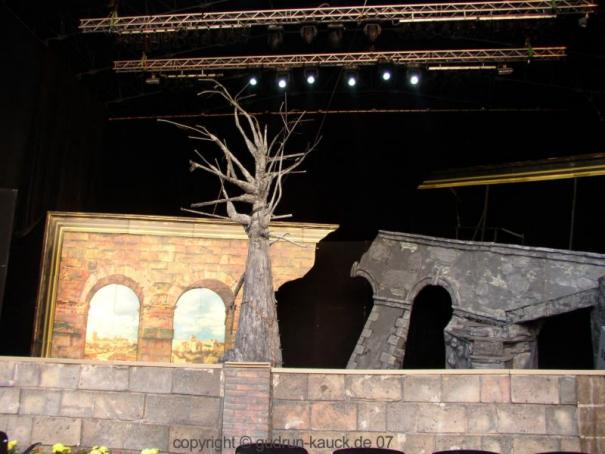
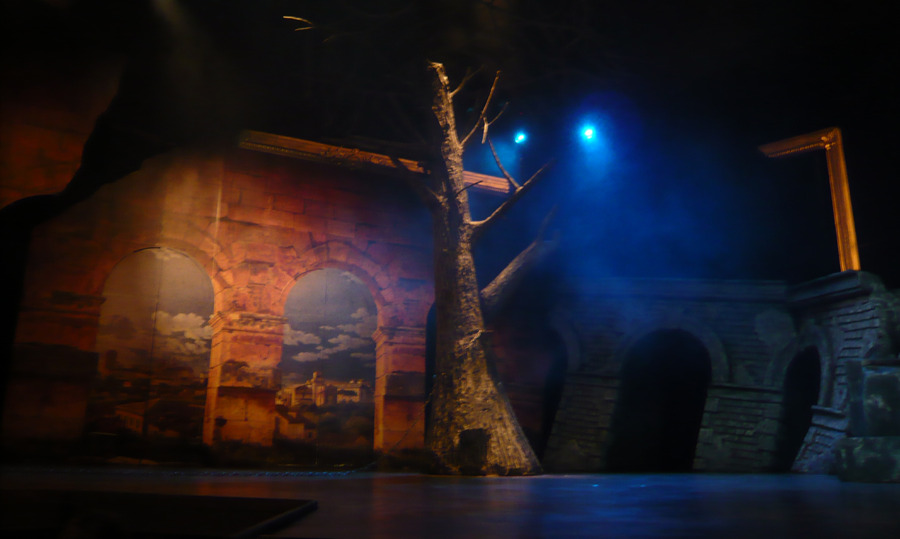
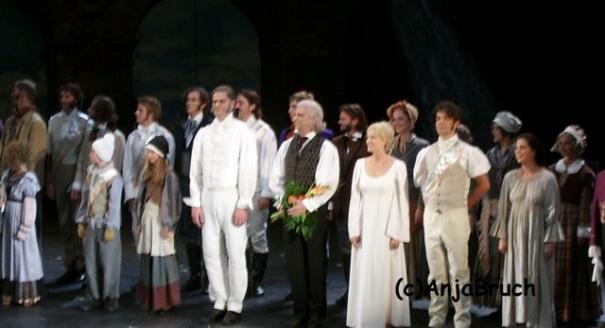
But still... I somehow imagined ÅST Les Mis was an original, something never seen before. How wrong I was. Many major motives I thought were unique to ÅST were actually repeats from the Füssen version. The tree that serves as a backdrop to every scene and becomes a part of the barricade. The little bridge on the right side of the stage. The doors with scenery in mock tile wall on the left. The doorways in mock stone wall on the right. The golden frames surrounding the stage. The white costumes for the dead characters. Even the colours of the lights during certain scenes...

All in all, I don't think this is very promising when you think about the upcoming TT production.

Again, this is pure speculation. But, looking at the two productions, it's impossible not to notice they're by the same creative team. For example: even when two versions of the same character's costume aren't exactly identical, Ellen Cairns's style is still so similar in both that you could swap the outfits without no one noticing.
There's been talk of the ÅST (and Füssen) Les Mis creative team being transported to TT as a whole, not just the director. I've no doubt they're all talented and versatile people. But still, I'm afraid the temptation to take the easiest route and do what was successful the previous two times is too strong.
We've heard the reasons. It was easier to get Cameron Mackintosh's blessing for the production by promising it'll be similar to the popular ÅST one. But still – I just hope they remember how small a country Finland is. When replicating, for a Finnish stage, an obscure German production that only ran for a month, chances are no one here has seen the original. But, as we know, Les Mis was ÅST's biggest success to date, there were certainly more than a handful of people who saw it. And Tampere is not that far from Turku...

TT Les Mis, please: surprise us.

Or at least fix the translation.
ÅST photos taken by Nana Simelius and Robert Seger. Füssen press photos from here, originally from All-in.de. Photos scanned from the newspaper by Jan van der Velden. Füssen barricade photo from here, Füssen Javert screencapped from here. As always, hover over the photos for specific info.
This site was a valuable source for this entry.

Saturday, September 15, 2012

The Kings' Speeches

The kings giving a speech: Charles Edwards on the left, Carl-Kristian Rundman on the right.

Last spring, I was lucky enough to see both the West End and Finnish versions of the play The King's Speech.
With musicals, it's surprisingly easy enough to see multiple versions of the same thing. Everyone (or at least several theatres in each of the Nordic countries) wants to have their own Les Mis, Next to Normal, Evita. You even have the term hit musical. Hit plays, on the other hand... Before this, I hadn't much considered seeing two productions of the same play. I had hardly considered seeing a straight play at all.
However, earlier this year, The King's Speech (or Kuninkaan puhe) premiered in Helsingin kaupunginteatteri. I saw it in April, and a month later, I found myself in London during the last week of performances of the West End version.

I consider The King's Speech, a real history based story about King George VI's struggle with stuttering and finding his place as the monarch of the Great Britain, a great story in any form. I loved the movie, just like the rest of the world did, and found the play just as good. I rarely cry while seeing musicals, even though most of the ones I enjoy are about dying and misery, but this play made me shed tears quite uncontrollably just when the curtain fell. In both countries.
I think the whole concept of royalty is interesting. How come it's possible that in 20th-century-and-onwards Europe, there remains a system where certain people officially have a certain stature just because they happen to be born to a certain family? I like how the play addresses those issues. Not to mention I think there's always something very interesting about stories that are based on real events.

Taking lessons. Jonathan Hyde and Charles Edwards on top, Pertti Sveholm and Carl-Kristian Rundman below.

I've been trying to make decisions (for the whole summer, it seems, since this post has been sitting in my drafts since May), but I don't think either of the casts I saw was stronger than the other. There were stronger individual performances, and maybe by mixing people from both you could have a sort of an ultimate cast – but as a whole, I enjoyed both casts about as much.

If I have to find differences, I think the Finnish one can boast a slightly stronger speech therapist Lionel Logue, portrayed by Pertti Sveholm. I thought his performance felt a tad more genuine than his British counterpart's, Jonathan Hyde's, though Hyde wasn't bad at all either.
There's a fun story relating to that bit of casting, though. The movie Titanic is one of my all-time favourites. So, you might've recognised the name and thought I was over the moon to see an actor who had a prominent role, as J. Bruce Ismay, in my favourite movie. Well, I'm sure I would've been – if I had known it was him! I simply didn't recognise Hyde onstage, nor did the name ring a bell. Back at hotel, I leafed through the programme and started thinking that no way, this says he was in Titanic, and he kind of looks like... could it be... I blame the lack of a moustache!

But resuming to the casts.
I'm afraid Vuokko Hovatta is one of those actors who simply annoy me, no matter the role. I've yet to see her in a part I'd honestly enjoy her in. True to my sentiments, I found her Elizabeth slightly annoying and lacking much emotion whatsoever. Therefore I enjoyed the British Elizabeth, Emma Fielding, better. Thinking about the other major female role – if we're being superficial, West End's Myrtle Logue, Charlotte Randle, seemed a bit too young to me. I don't know her actual age age, but she has such a young look I felt she could've almost been Jonathan Hyde's daughter. I preferred the Finnish version, with Eija Vilpas as Myrtle, since the couple seemed closer to each others' age. When it comes to actual performances, though, I think the both did a good job.
Continuing the nitpicks, I found the Charles Edwards's stutter, as King George VI (or Bertie), more believable than Carl-Kristian Rundman's. Then again, I don't really know anyone who suffers from stutter, not anyone Finnish nor anyone who speaks English. So who am I to judge? Other than that, I'm afraid I can't pick a favourite king, they both gave great performances.

Unlike the casts, the stagings differed a lot. Musicals, no matter if non-replica or not, tend to be staged a bit similarly everywhere. So, it was interesting to see how much the visions can vary when it comes to staging a play.
I think Helsingin kaupunginteatteri's big scene is simply too big. I think there's too much space even for the hugest productions, like Wicked. But here, for once, the emptiness worked for the piece's advantage. I felt the king's loneliness and helplessness more achingly when I saw him struggling to give a speech in the middle of the vast space. The West End stage, at Wyndham's Theatre, was a lot more intimate. While the smaller space usually felt better, and there was no need to keep ensemble howering awkwardly at the background just to fill the room, the extra space certainly added feeling to the speech and church scenes at Helsinki.
HKT solved some of the space problems by adding a sort of a smaller stage, that served as a room, in the corner of the stage. In Wyndham's Theatre, then, they had a turntable with a big wall that rotated when there was a change from one space to another. I have to give a nod to Logue's office in the West End, it looked way more cosy there!

Top, Michael Feast, Ian McNeice and David Killick as the Archbishop of Canterbury, Winston Churchill and Stanley Baldwin. Below, Rauno Ahonen and Jari Pehkonen as the Archbishop and Churchill.

Direction-wise, HKT's under Kari Heiskanen's helm and West End by Adrian Noble, there were of course differences. I think even the scripts differed a bit, in ways that can't be blamed for confusion in translation. For example, I seem to recall the scene where the leaders of the land discuss at the urinal had rather different lines depending on the country (also noteworthy: in Britain, the scene was not urinal-based). The West End version gave the Nazi threat more emphasis. 

All in all, and maybe not surprisingly, the British version felt a bit more reserved. I think one of the most interesting differences was at the very end of the play [here be spoilers!]. In the Finnish version, after the line Thank you... my friend, Bertie and Lionel hug. In the British one, there was just a handshake.
The hug seemed like a very natural ending to me, and I was a bit surprised the West End version didn't have that. I felt it lacked something. Then I started wondering... maybe there are still some taboos considering the royalty in the UK? After all, even as a Finn, it's quite impossible to imagine the Queen hugging anyone. I guess that, to us Finns, the piece plays as any piece of historical fiction – maybe based on real events, but still fictional. If it suits the characters, we think it's normal when the King of Great Britain and his best friend share a brohug. But maybe that's too unbelievable for the British, some of whom might consider this not yet fiction but still real history?
Or maybe I'm reading too much into this one little detail. After all, apparently you can have the King creatively and repeteadly use a variety swearwords in that one famous scene, no matter which country.

In the West End, I sat next to a very nice old lady. Upon seeing me wipe my tears after the show, she opened a conversation, and told me she remembers the time George VI was crowned. To me, a Finnish teenager, the events portrayed in the play are very distant. Events like the ones the play's about don't feel very real to me. I know they have happened, but somehow it's a bit hard to believe.
So, it was eye-opening to talk to someone to whom they're real memories from her own childhood. The lady told me she loves the movie and that she enjoyed the play a lot too. She was also a true royalist and expressed her sympathy when I mentioned us Finns only have presidents... So I suppose the historical characters and events have been treated with certain respect and style.

I'm always curious to observe the audience reactions. I've seen the play three times now, twice at home and once abroad. Out of these, the first Finnish one had a dead audience, the second Finnish set seemed to be enjoying themselves a lot, but the British were simply roaring with laughter. I think it's a national difference. I've a feeling it's a lot quieter in Finnish theatres, no matter which show.

At last, the triuphant speech. Charles Edwards on the left, Carl-Kristian Rundman on the right.

Finally, I want to tip my hat to the British production for starting to renovate their theatre at the time I visited. I had bought the cheapest, worst balcony seat. When climbing upstairs, I found out the balcony's under renovation, and got relocated in the best seats of the theatre, right in the middle of the royal circle!
That stroke of luck was like a cherry on top of a great experience. The King's Speech was, after all, the first West End play I've seen. I think I should see a straight play during every visit to London from now on! And when it comes to seeing straight plays in Finland, The King's Speech was also a bit of a first: it's the first play I've ever seen completely voluntarily, not for school credit or because someone invited me. I was surprised to enjoy it as much as I did, and I'll definitely keep an eye out for interesting plays in the future.

Photos of the West End production from their website's gallery
Photos from the HKT production by Tapio Vanhatalo.

Friday, August 10, 2012

Aladdin the Musical

Yesterday, I attended the premiere of Polar Illusions' production of Disney's Aladdin.
Polar Illusions is a brand-new company that specialises in musical theatre, and Aladdin, directed by Samuel Harjanne, is their very first show. The company mentions increasing the quality of Nordic musical theatre as their goal. I was curious to see if their first production is a step towards the right direction.


Aladdin is one of the best-known Disney films, and the musical's plot followed the movie quite closely. It had, expectedly, to cut some of the big action scenes, but the basics were there: the poor guy, the princess, the genie, the magic carpet ride...
I guess I could've also expected the musical to have very little actual music. The original movie has five songs and two reprises. Even though many songs were cut from the movie before it was released, only one of them made a return onstage, resulting in a musical with six songs and their reprises. The show, however, was quite short, so that didn't matter too much. The movie's songs are classics, they sounded amazing live. The one extra song... we'll come to that.

The most interesting part about this production, to me, was the fact it's in both Finnish and Swedish (originally, this version was done in the USA in English and Spanish). It's nice to see bilingualism celebrated by a piece of theatre that uses both of the official languages of this country. Sadly, I can't help wondering if the script to the bilingual version was written by people who just don't really care.
In my opinion, the bilingualism brought nothing new to the story. It sounded like a good idea that the people of the street and the court would speak different languages, and I was looking forward some commentary about how this affects the relationship in between the Sultan and his subjects. There was hardly any mention of that, you mostly had either these annoying narrator characters or one of the talking animals translating everything into the other language. The ending, where (very meek spoilers ahoy) the curse is lifted and the people of Agrabah are able to understand each other again, was anticlimatic. So what? The audience never felt for their problem. They could've also squeezed more jokes out of the language gap.
When it comes to Aladdin and Jasmine, their animal sidekicks acted as their interpreters. Seemed like a copout to me. I'd have loved to see Aladdin and Jasmine struggling with the languages, understanding a word here and there, falling in love nevertheless and learning to understand each other as the story progresses... Where's the challenge if you have a translator with you at all times?

Finally, I think the fourth wall was broken a time too many. I didn't care when the Genie did it, he's a supernatural creature - but a little of that stuff goes a long way. I think it'd been better if the rest of the characters had been unaware of the audience.


When it comes to the cast, I enjoyed everybody. Highlights were Antti L. J. Pääkkönen as the Genie and Anna Victoria Eriksson as princess Jasmine. The former was full of energy and managed to fill the huge shoes worn by Vesa-Matti Loiri of the Finnish film dub, the latter has just the right amount of attitude, and, in my opinion, way too little time onstage and few songs to sing. Jon-Jon Geitel was not bad in the title role, either. Almost everybody had a crush on Aladdin as a kid, so it's again hard to live up the expectations – and while Geitel wasn't identical to the movie, I think he didn't disappoint.

I've got a big problem with the villain Jafar. Not with the actor: Markku Nenonen did his best with the material he was given. But the material... Many Disney villains serve as comic reliefs. They have their one-liners and silly moments, but there's always the dark and evil side bubbling under. Too bad the musical's Jafar has no malice at all. Just mincing and prancing onstage. I think, for the campy moments to be funny, his default setting would have to be more serious.
As Disney fans know, Jafar hasn't got a proper song in the movie, so I was happy they added one for him here - for about five seconds. Jafar's solo was the least threatening villain song ever. For a bad guy like him, you think something among the lines of Be Prepared and Poor Unfortunate Souls... Nope. He got this. It's very easy to see why that didn't make it to the movie. Even though Jafar had a couple of moments to be genuinely threatening in the show, a song like that was quite enough to make the efforts useless. The villain became a clown, the story lost a part of its driving force.

I liked the visuals of the production well enough. The costume designs especially were very close to the original movie - but, for whatever reason, it didn't bother me this time. It was actually nice to see the cartoon characters become flesh and blood like that. I suppose I wouldn't have minded a different take, either, but I wasn't annoyed by the replicating.
I think I was the most impressed by the way they staged the Genie's first song, A Friend Like Me. Matching the visual insanity of the movie scene must've been a hard task... having the whole cast as genies dancing onstage looked amazing!


In short, however, I'm afraid Aladdin the musical doesn't rank too high on my list of musical adaptations. The cast and crew are talented, there are fun moments and good songs, but the script and especially the use of the two languages are a bit of a mess. If you're a huge Aladdin fan, you'll enjoy the movie better... and if you're not, you'll probably still enjoy the movie better.

I'm still intrigued by the idea of bilingual theatre and wish Polar Illusions all the best for the future. It's clear the company has enough talent to create a great show. Let them just pick one with a more solid script next time.

Photos by Matti Rajala.
My blog entry from the time of Aladdin's press release event: click
Thumbs down for not singing the baklava line in A Friend Like Me in Finnish.

Sunday, July 29, 2012

Price Politics

It's again the time of the year to ponder about the upcoming musical season, and to buy the tickets yet unbought!
It's also the time to get angry about the prices, and to openly weep after spending an unthinkable amount of money on the tickets anyway.

I know seeing theatre in Finland is cheap compared to West End, let alone Broadway. We don't have to pay hundreds for a good ticket. But still - for a system that, thanks to public funding, doesn't have to cover all expenses with the ticket profit - there are some weird things going on.
I suppose theatres should do their best to get us hooked young. Correct me if I'm wrong, but I believe a person who learns to enjoy theatre at a young age will keep visiting later in their life, instead of thinking theatre's a waste of time only elitists enjoy. However, no student is made of money, and theatre is never as cheap as pretty much any other activity out there. So I suppose keeping the student prices affordable would be a good idea. We fall in love with the genre now and will return to pay the full price a couple of years later.
Sadly, it's not always as simple as that. Student discounts, while they exist, are usually very small. And then there are the theatres that seem to specify in frightening young people away...

Helsingin kaupunginteatteri annoys me the most. According to their logic, people such as students and pensioners simply don't exist from October to December, and for the most of the year, they stop existing on weekends.
HKT has a pricing system where certain months are more expensive than others. Ironically, during the most expensive months, the theatre doesn't offer students the usual 6€ discount (let alone the incredible 2€ discount for pensioners, for that matter). During the most of the time, the discounts only exist during weeks, at weekends everyone has to pay the same price.
HKT, here's the thing: maybe it's surprising, but students also have things to do during the week, just like everyone else. Going to school, for example. So most of us would rather see theatre on the weekend. I think a pricing system like this has some nasty implications. Of course, it may be debated if anyone who really wants to see some play changes their mind because they can't get that 6€ off, but it still sends a message: students are second-grade theatregoers who can be used to fill the empty seats on the days no one else wants to see shows.

Similar attitude lurks in other theatres, too. In Åbo Svenska Teater's Hair, students can get whole four euros off from the best and tolerable seats - and then 11€ off when it comes to the rickety stools where you can see about half of the stage. Sounds fair? It'd be, if they also warned the first-time visitors that they won't be getting a good view. As is, I haven't managed to find any warning on their website. Even though weirdly cheap price is usually an indicator of something being off, I think it's always nice to say that out loud too.
Svenska Teatern with their Kristina från Duvemåla is a lot worse, though. The prices are sheer robbery: the cheapest ticket for the remaining 2012 season costs 45€ for a student. People have complained that you can hardly see the stage from those. Svenska Teatern doesn't like making that fact very clear either, but luckily they'll change the system a bit for 2013: the worst seats will be considerably cheaper. Too bad the most expensive tickets, which compose the biggest part of the auditorium and cost 65€ for students these days, will get more expensive. In theory, I guess if people are willing to pay - and they seem to be, since the show's sold out for months in advance -  you can ask for as much money as you want. But I don't know if asking over 70€ per seat where you can actually see is the best way of making young people interested in your show. I love Kristina to bits (more about that later) but I'll have to think about seeing it multiple times pretty carefully.

RENT at Alexander Theatre also peeves me. Even though RENT is partially starting to morph into a nostalgia trip for people who were teenagers when it first premiered in the 90's, it's still not exactly for senior citizens. So, I was rather surprised to see there's no student discount available, that the tickets cost from 43 to 48€, and that apparently only the more expensive ones can be bought via internet.
Compare to Suomen Musiikkiteatteriensemble's RENT from 2011: 16€/student. Compare to Aladdin, the other musical premiering in Alexander Theatre this fall: 25€/student. When you remember Aladdin is the Disney one that has a flying carpet, and RENT is the one about poor artists where traditional set design consists of a table and a string of light bulbs... I can't, of course, know the reasons behind the pricing of RENT's tickets (who knows if the production will be filled with pyrotechnics?), but I feel very discouraged to see it for such a bloated price. It's hard to imagine RENT as a theatre event for middle-aged people to sip at their glasses of champagne - but since there's zero effort towards making it affordable for young people, I suppose that's what they're aiming for.

When will we see the first Finnish theatre following in the footsteps of the National Opera and offering students tickets that cost 50% of the normal price?

Other ideas (theatres, feel free to steal): 
Det Ny Teater (Copenhagen) style: discounts for everybody under 25 years old - a student or not.
Ryanair style booking system: book early, pay less.
Last minute discount: big discount if you buy a ticket for a show on the same day. 
Car wash style: get every 6th play for free.

Wednesday, July 18, 2012

Let the Spectacle Astound You

I've been meaning to write about this show ever since I started this blog. However, each time I try, it turns out I have nothing to say. 

Let me break this summer hiatus by trying once more.


The overture to The Phantom of the Opera is one of my favourite theatre experiences.

It's neat enough when you listen to it from a cast recording, but - as is the case with all great theatre moments - nothing can compare to seeing it live. To sit there in the theatre, when the chandelier rises, when the music blasts and you feel the notes going through your body... I get excited just thinking about it. It's like a promise: you'll see a great show tonight!

I've been to London (after falling in love with musical theatre) without seeing Phantom only once. It's a staple like Les Mis: I don't have to ponder about getting tickets at all. I go to see it, marvel the huge scale of the production... and leave without having gained much anything at all, beyond some delicious eye and ear candy.

I keep returning to Phantom because I remember seeing it for the first time. I was amazed. I had never seen a show as big, a show as beautiful. It still ranks there as one of the most visually gorgeous shows I've ever seen. I see it for my favourite moments: the Overture, the dropping of the chandelier, the intense Final Lair scene...

I don't see Phantom to get any food for thought. I don't see it for the performances, either. While I'm sure I could tell an awful Phantom from a good one, ranking the good ones I've seen is something else. Last summer, I saw John Owen-Jones, the man many Phantom fans praise as the best Phantom ever. I can't really remember what, if anything, made his performance different from the others I've seen.

There are the couple of musicals that seem to be less about the performances and art, and more about the show, or phenomenom, itself. Shows like Les Mis, Wicked and Phantom - I feel they, in their West End forms, are quite centered around their reputation as the world's favourite musicals.

Entering a theatre in Finland is entering a theatre. Entering a theatre in West End, then? When it comes to the type of shows I mentioned, I feel it's like visiting Disneyland. The place is crowded with travellers and complete with souvenir stands, ice cream and people in costumes. Cameras flash during the intermissions, lines to meet and greet with the stars are formed after the show.

Many of the most popular productions in London hardly feel like pieces of theatre to me anymore. They feel like tourist attractions, every single detail perfected - every single detail always similar. I suppose, when you change casts for 26 years in a row, everything has to be fixed so you can change one person without everything falling apart. And I suppose some of the tiniest movements the original cast happened to come up with 26 years ago are indeed still intact.

In short: visiting Her Majesty's for Phantom from year to year, the tourists sitting next to me change, the actors change. The experience stays the same.

That is why I find it so hard to review Phantom.

I feel it's pointless to talk about the piece itself. I'm sure everyone has seen it, every opinion out there has been expressed already. I like the show well enough, but I'm not into it enough to notice the tiny differences in between performances, so deeper analysis is ruled out.

I just keep seeing the show to enjoy the spectacle, to rest my eyes on the glitter and glamour for two hours and a half.

Photo from Phantom of the Opera's photo gallery.